Whitepaper
Accelerating Electrification of School Bus Fleets
Across the US, school districts are choosing to electrify their school bus fleets. The change is driven by the benefits electric buses provide to students’ health and local air quality, the potential for cost savings, substantial available federal grant funding, and mounting pressure school districts face to decarbonize their operations.
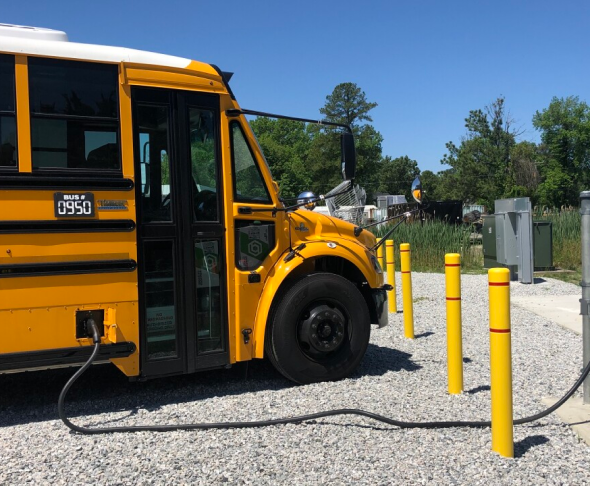

School districts eager to transition their fleets to electric school buses must navigate a thicket of financial and operational concerns that fall well outside the usual purview of school administrators and other traditional fleet maintenance operators. Sizable upfront costs, technical and bureaucratic hurdles, and a bevy of market uncertainties all complicate the path forward to a greener, cheaper, and healthier EV bus fleet. Overcoming the triple barriers of cost, complexity, and uncertainty requires business model innovation and adoption. Fortunately, the innovation already exists, and it’s becoming widely accessible to school districts. As the stakes for large scale electrification loom ever higher, the fleet electrification-as-a-service (FaaS) model is simplifying and accelerating the electrification process for essential audiences – public schools and the children and families they serve.
Our whitepaper distills our proprietary research and analysis to explore how the fleet electrification-as-a-service model is simplifying and accelerating bus fleet electrification for essential audiences: public schools and the children and families they serve.
Contributors

Generate Capital
Ryan Miller
Principle, Investments

Logan Goldie-Scot
Director of Market Research
Berk Manav
More insights
Accelerating Electrification of School Bus Fleets
Transitioning school bus fleets from diesel to electric models carries significant health, environmental, and cost benefits. Persistent challenges have to date impeded electric school bus adoption, but solutions are at hand.
Read moreWhy the infrastructure transition needs creative credit
Private credit has stepped in to help fill some of the biggest gaps in our capital markets in recent years.
Read moreAlternative Delivery: Exploring Beyond Traditional Execution Models to Deliver Better Assets Faster
In the United States, we are in the midst of a once-in-a-generation initiative to rebuild our nation’s aging infrastructure and transform our built environment to support sustainable and inclusive future growth.
Read more